Materials
Quantum dots and size-dependent colour
Take a semiconductor crystal and shrink it until it is only a few nanometres across, and something striking happens: its colour starts to depend on its size. Quantum dots are the clearest everyday demonstration that the nanoscale is a different physical regime, not merely a smaller one.
Artificial atoms
The Wikipedia article on quantum dots describes them as semiconductor particles a few nanometres in size whose optical and electronic properties differ from those of larger particles because of quantum mechanical effects. When a dot absorbs light, an electron is lifted to a higher energy level; when it falls back, the dot emits light whose colour is set by the gap between the allowed levels. In a crystal this small, electrons are confined in all three directions, so those levels are discrete, much like the levels of an atom. That is why the article notes that quantum dots are sometimes called artificial atoms.
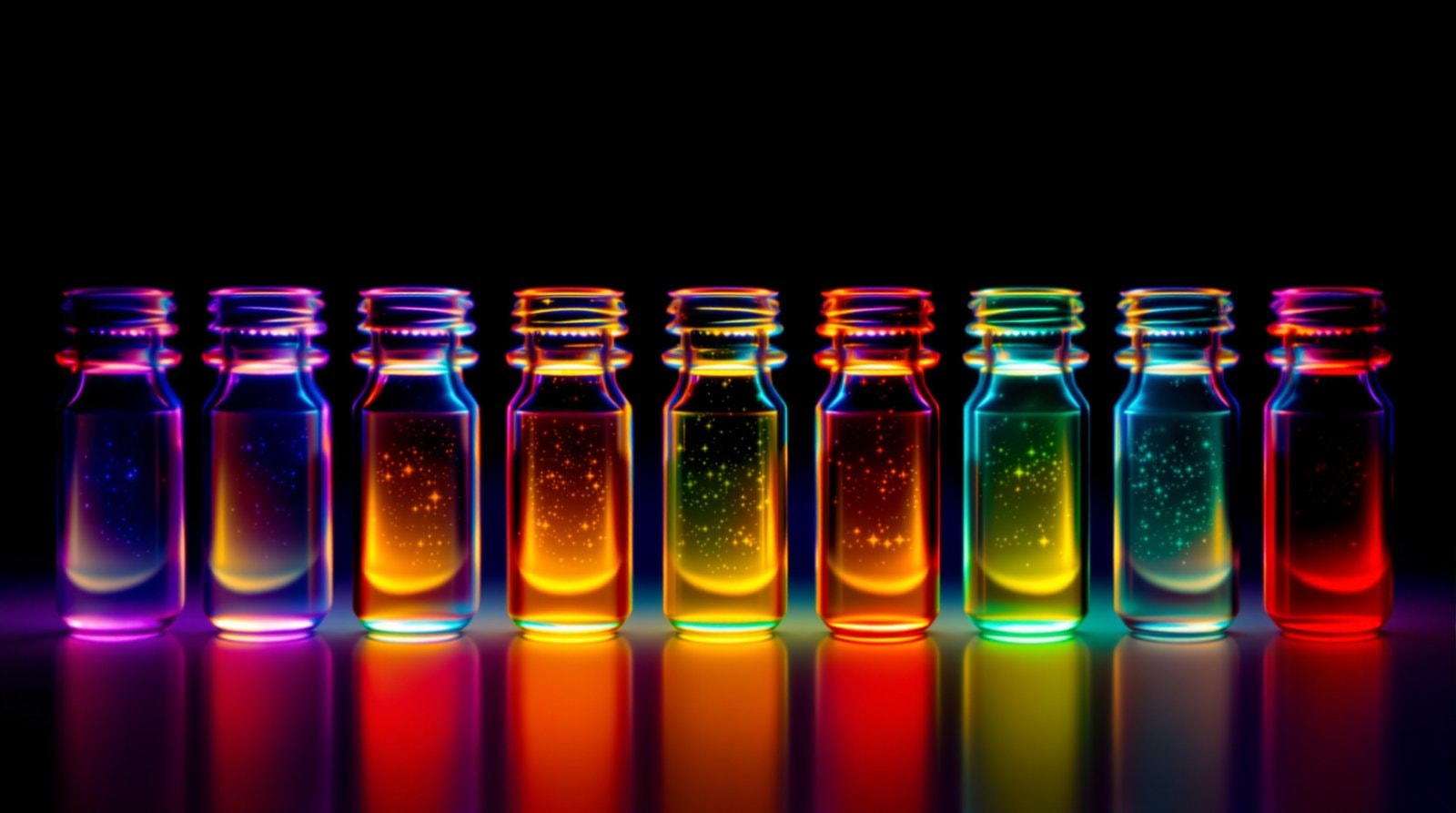
The size dependence follows directly. The smaller the box, the more widely spaced the energy levels and the bluer the emitted light. The article gives the rule of thumb in concrete terms: larger dots of 5 to 6 nm diameter emit longer wavelengths, in colours such as orange or red, while smaller dots of 2 to 3 nm emit shorter wavelengths, in blue and green. One material can therefore be tuned across the visible spectrum simply by controlling how large the crystals grow.
Discovery, twice
The Nobel Prize popular information for the 2023 chemistry prize tells how the effect was found independently in two places. In the early 1980s Aleksey Yekimov created size-dependent quantum effects in tiny crystals within coloured glass and published the discovery in 1981 in a Soviet journal that was hard for researchers on the other side of the Iron Curtain to obtain. Louis Brus, working at Bell Laboratories and unaware of that work, became in 1983 the first researcher to observe size-dependent quantum effects in particles floating freely in a solution.
For the next decade the difficulty was quality. Particles made in solution came out in a spread of sizes, and sorting them afterwards was laborious. The prize text describes how Moungi Bawendi, who began postdoctoral work in Brus's laboratory in 1988, went on to transform the production of quantum dots in 1993, making crystals of very high quality, which it calls a vital prerequisite for their later use. The 2023 Nobel Prize in Chemistry was awarded to Bawendi, Brus and Yekimov for the discovery and development of quantum dots.
How they are made
Several routes exist. The Wikipedia article lists colloidal synthesis, self-assembly and electrical gating among them. The colloidal route, which dominates the chemistry literature, grows the crystals from precursors in a hot solvent; the article notes that the product neither precipitates as a bulk solid nor stays dissolved, but remains as a suspension of tiny crystals. Organic molecules bound to the surface, known as ligands or capping agents, keep the crystals apart and control their growth. A second, wider-gap semiconductor grown as a shell around the core can protect the dot and improve its brightness, which is why so many papers describe core–shell structures.
A separate tradition in physics makes quantum dots inside solid semiconductor layers, either by patterning or by letting islands form spontaneously during crystal growth. Those dots are studied for single-photon sources and quantum information rather than for colour, and they appear mostly in the physics journals.
From physics to biology
Bright, stable, tunable emitters are exactly what biologists need for fluorescent labelling. In a 1998 Science paper, Bruchez and colleagues reported preparing semiconductor nanocrystals as fluorescent probes for biological staining. Their abstract highlights a narrow, tunable, symmetric emission spectrum and photochemical stability compared with conventional fluorophores, and describes a labelling experiment on mouse fibroblasts in which one excitation source produced two emission colours. The authors concluded that the nanocrystal probes were complementary to existing dyes and in some cases might be superior. That paper is a good example of the cautious language a reader should notice: the claim is comparative, specific and hedged.
The practical problems that followed, how to make dots dispersible in water, how to attach them to biomolecules, and how to keep them from clumping or losing brightness, occupied a large part of the chemistry and materials literature in the years around 2001 and 2002; the page on that period places them in context.
Reading quantum-dot papers
Three things are worth checking in almost any paper on colloidal quantum dots. First, the size distribution: an emission peak is only as narrow as the spread of sizes behind it, so look for the measured distribution, not just an average. Second, the surface: ligands and shells change brightness, stability and toxicity, and a result obtained with one surface chemistry may not hold for another. Third, the comparison: claims of superiority over conventional dyes or materials depend on which ones were chosen for comparison and under what conditions.
Related subjects appear on other pages: the size-dependent colour of metal particles on metal nanoparticles, the general reason small things behave differently on what nanotechnology is, and questions about how nanoparticles behave in living systems on nanotoxicology.